
How to count marketplace sales in your ad performance
· 8 min read
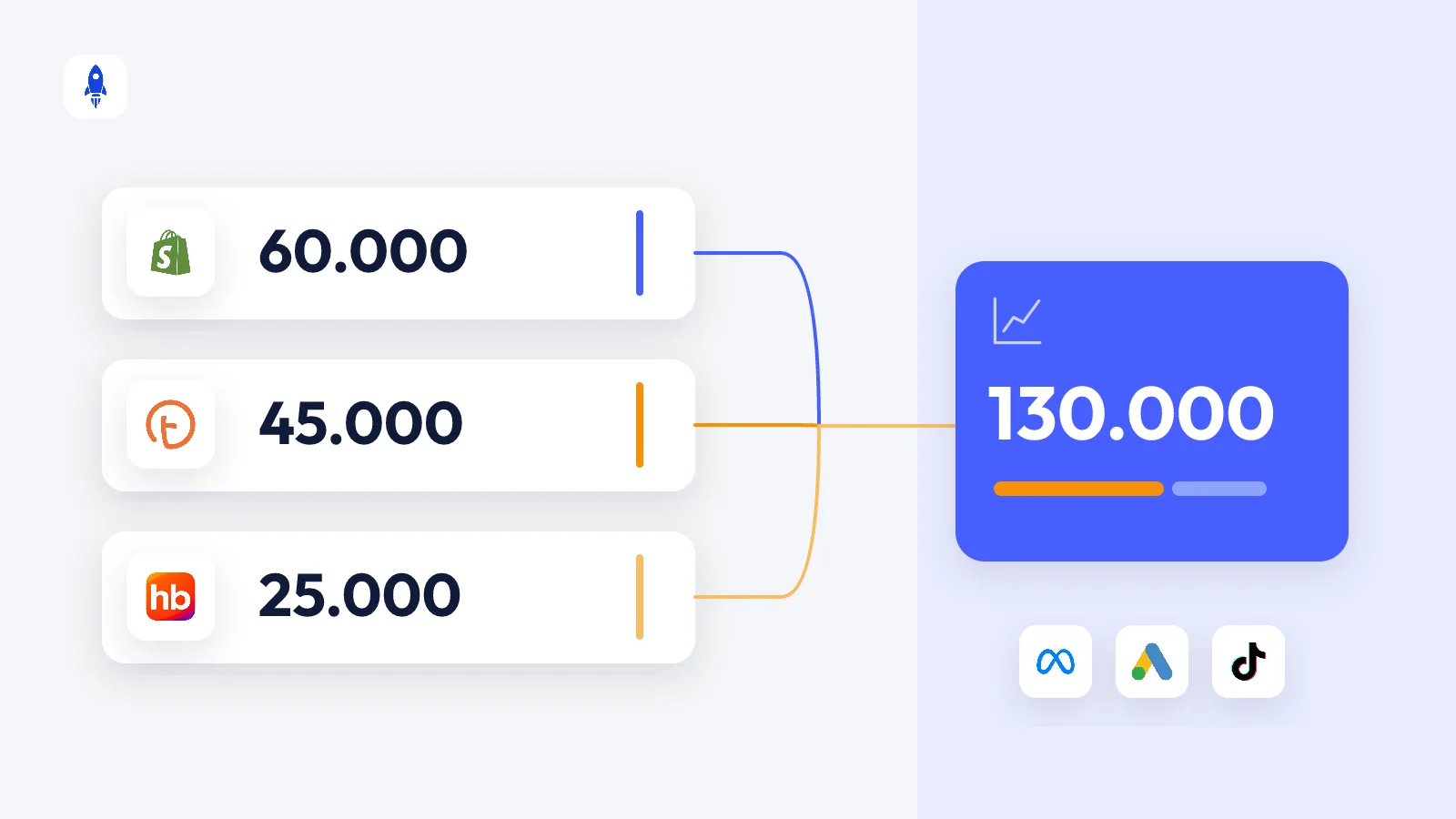
Social and search ads send customers not only to your website but also to your marketplace store — yet those sales are invisible to the ad pixel. To see the effect, read the total revenue of all sales channels together with total ad spend.
How do ads affect marketplace sales?
In Türkiye, many customers discover a brand on Instagram but buy on the marketplace they're used to — their saved card, shipment tracking and easy returns are there. Your ad introduced them to your brand, but because the sale happens on Trendyol, Hepsiburada or n11, Meta or Google will never see it.
The result: platform ROAS understates the real effect of your ads. A team that only looks at platform numbers might switch off a campaign that's actually driving sales because it “loses money”.
How can you see this effect?
Order-level matching isn't possible on marketplaces — customer data stays with the marketplace. Instead, you use an aggregate view:
Blended ROAS
Add up revenue from your website, marketplaces and any physical store, and divide it by total ad spend. This number doesn't care which platform claims what; it answers “how does our ad spend relate to the business's total revenue?”
MER (Marketing Efficiency Ratio)
MER uses the same logic but also includes non-ad marketing costs (agency fees, influencers, content production). It's a more holistic measure for management reports. We explain the difference between ROAS, POAS and MER in our guide to calculating ROAS.
Channel share and change over time
Change matters more than any single week's number. If marketplace revenue rises in the period you increase ad budget, ads have a spill-over effect on the marketplace. If marketplace sales also fall when you cut budget, the relationship gets stronger.
How do you measure it in practice?
- Bring all sales channels onto the same date range. Website, each marketplace and offline sales — separately, but on one calendar.
- Track net marketplace revenue. Use the figure after cancellations and returns, with campaign discounts reflected.
- Log budget changes. Record changes like “we raised Meta budget by 30% this week” with dates, then watch how channel revenue responds.
- Run controlled tests. If possible, pause ads for a product group for a set period and watch how those products' marketplace sales change.
- Keep marketplace ads separate. In-marketplace ads (such as sponsored products) target that channel's sales directly; don't lump them together with social and search ads.
How does marketplace commission change the ROAS maths?
A sale on a marketplace has a lower margin than one on your site — commission, shipping share and campaign participation reduce profit. So when interpreting blended ROAS, adjust your break-even point to your channel mix. If half your sales come from marketplaces, your average margin is lower than a site-only calculation suggests, and your target ROAS rises accordingly.
The most common mistakes
- Crediting all marketplace revenue to ads. The marketplace's own traffic and organic search also drive sales. Blended ROAS shows a relationship, not exact attribution.
- Cutting budget based on website ROAS alone. It ignores that marketplace sales may also drop when ad budget falls.
- Reporting channels on different days with different definitions. If the marketplace report lags a day and the website report is current, the comparison misleads.
The bottom line: the whole picture on one screen
Seeing marketplace, website and ad data in one table is the most practical way to understand the real impact of your ads. Instead of collecting it by hand every week, a dashboard like CiroFly lets you follow Trendyol, Hepsiburada, n11, Çiçeksepeti and Pazarama revenue next to Meta, Google and TikTok spend on one screen.
Frequently asked questions
Do Meta ads increase marketplace sales?+
Often, yes — some customers who discover your brand through ads buy on a marketplace. Those sales don't show up in Meta, but the effect can be seen when you track total revenue against total ad spend.
What is blended ROAS?+
Total revenue from all sales channels (website, marketplaces, physical stores) divided by total ad spend. It isn't affected by attribution overlap between platforms.
Can marketplace sales be sent to ad platforms?+
Marketplaces don't share enough customer data with sellers for ad matching, so the effect is read through total revenue and change over time rather than per order.
Does marketplace commission affect target ROAS?+
Yes. Commission and campaign participation lower your margin; if most of your sales are on marketplaces, both break-even and target ROAS go up.
See your ad, store and marketplace data in one dashboard
CiroFly combines your sales and ad channels and updates ROAS, revenue and channel breakdowns automatically every day.
Related articles

How to calculate ROAS in e-commerce — and what is a good ROAS?
The ROAS formula, how to work out break-even ROAS, how VAT and returns affect it, and how to set a target ROAS for your brand step by step.
12 e-commerce KPIs you should track (and how to calculate them)
Formulas for revenue, orders, average order value, conversion rate, ROAS, customer acquisition cost, lifetime value and other e-commerce KPIs — and how to read them.
What is the Meta Conversions API (CAPI) and why does e-commerce need it?
How the Conversions API captures sales the Meta Pixel misses, how double counting is prevented, Event Match Quality, and what to check when setting it up.